
Kong Vang, RT (R) (T) and Erin Ambroziak RT (R)(T), Assistant Chief Therapist, South Sacramento Cancer Center
SGRT in the Daily Treatment Workflow
As radiation therapists, our priority is delivering accurate, efficient treatments while making the experience as comfortable as possible for our patients. Surface guided radiation therapy (SGRT) has become an important part of how we do that. At South Sacramento Cancer Center, our hands-on experience with C-RAD has shown us that SGRT is most valuable when it fits naturally into our workflow and supports the way we work at the console every day.
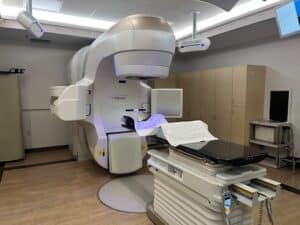 We use SGRT where we see the greatest clinical benefit. In our experience, SGRT is especially effective for thoracic cases, where respiratory motion and precise positioning are critical. Today, we routinely use C-RAD for breast, lung, and esophageal patients. The C-RAD Catalyst+ HD SGRT system integrates well with our Varian linear accelerators, without adding unnecessary complexity.
In particular, the linac integration is very tight with automatic beam holds. When monitoring patients using C-RAD, with or without breath-hold, if a patient was to cough, sneeze, or adjust in any way from where we set them up, then the beam would be held. The radiation beam terminates when the motion moves the patient out of the planned tolerance as well as on breath-holds if they were not in the planned threshold (meaning too large of a breath or not large enough of a breath).
Learning Curve and Workflow Efficiency
As with most new technologies, we had a learning curve with SGRT. We weren’t directly involved in the original purchasing decision, but once the system was in place, and we began using it consistently, the value was clear. As we grew more comfortable with the technology, our confidence increased, and so did our efficiency. Over time, setup became smoother and more predictable, and SGRT evolved from something new into a trusted part of our workflow. We believe the 6-DOF couch integration also really aids in the speed of setups, and the technologies complement each other well.
Tattoo-Less and Mark-Less Patient Setup
One of the biggest improvements we’ve seen since implementing SGRT is the shift to tattoo-less and mark-less setups. Before SGRT, many breast patients required visible Sharpie marks or tape on the chest to help with alignment. With C-RAD, those markings are no longer necessary. We can position patients accurately without tattoos, pen marks, or stickers, which makes a meaningful difference in how patients feel during treatment. Preserving dignity and reducing visual reminders of illness has had a noticeable impact on patient comfort and confidence.
Visual Coaching and Breath-Hold Guidance
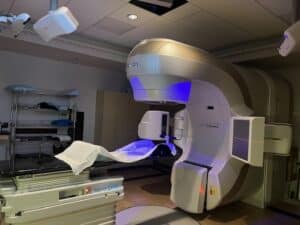
Our patients and clinical team also appreciate the visual light coaching panels from C-RAD, which are used routinely for DIBH treatments. The light system is installed on the ceiling of the vault and indicates the perfect breath-hold, making the patients in control of their own treatment. The patient is told that they only need to hold their breaths as long as they feel comfortable and if they need to breathe normal at any time, then the “green” light will turn off, the radiation will turn off. Then whenever the patient feels ready and comfortable again, they can take in a breath and hold it.
Also, C-RAD has the option of changing which color lights work best for each department. Our center specifically uses a pale blue light for normal breathing or when the patient is considered below the acceptable breath-hold threshold. We use a solid green light when the patient’s breath-hold is considered “perfect” or within the planned threshold and, finally, a yellow light when the patient’s breath is too large or above the planned threshold.
Comparison with Other SGRT Applications
We’ve also worked with other SGRT platforms and found that core functionality is generally similar across systems. However, some solutions require additional accessories to be placed on and removed from the treatment couch, which can add steps and slow things down. Every now and then, the shift refresh feels a little slow, but we’re also aware that we may just be impatient and trying to move faster than the technology is designed to move.
The Therapists’ Perspective
From our perspective, in summary, SGRT delivers the greatest value when it supports real clinical workflows. By integrating smoothly into our daily routine, minimizing extra steps, and improving patient interactions, C-RAD helps us work more efficiently while maintaining high standards of accuracy and safety. For us, SGRT isn’t just a technology upgrade: it’s a practical improvement that enhances how we care for patients every single day.

You might also be interested in


