
With Catalyst⁺ HD and Sentinel 4DCT, Chris O’Brien Lifehouse has built a unified SGRT workflow that supports motion management, consistent setup, and confident treatment across diverse disease sites.
At Chris O’Brien Lifehouse in Sydney, Australia, precision extends beyond a single treatment type. With multiple Varian TrueBeam linacs and C-RAD Sentinel™ 4DCT and Catalyst⁺™ HD systems, the center applies surface guided radiation therapy (SGRT) across a growing range of indications—from breast and chest to lung, abdominal SBRT, and limbs.
Since implementing C-RAD SGRT in late 2022, Lifehouse has expanded to more than 350 SGRT-guided treatments each year, including the majority of its 400 annual breast DIBH cases.
“Motion management is the real value of SGRT,” says Kate Ford, Assistant Director of Radiation Therapy and Head of Treatment at Chris O’Brien Lifehouse. “It’s allowed us to standardize breath-hold and gating techniques across sites, improve setup quality, and increase therapist confidence in every case. Our decision to adopt C-RAD SGRT solutions was driven by workflow integration, interface usability, and patient-centered visual feedback.”
“Our decision to adopt C-RAD SGRT solutions was driven by workflow integration, interface usability, and patient-centered visual feedback.”
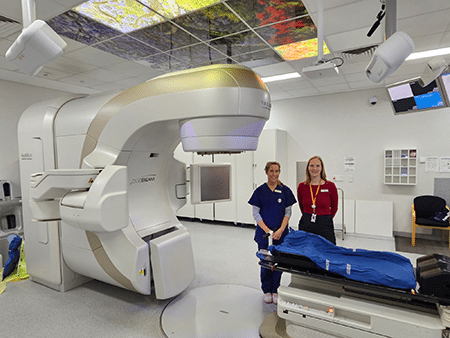 “The interface was far easier for staff to learn,” Ford notes. “And C-RAD’s Visual Coaching Light Panels give immediate feedback to both therapists and patients. For motion management, that’s essential.”
During early commissioning, the team found that light-based feedback also improved accessibility for patients with hearing impairments, a small but meaningful clinical advantage.
Integrating SGRT Across Multiple Indications
The Catalyst⁺ HD wide-field, high-resolution 3D cameras capture full-body geometry with sub-millimeter accuracy and provide continuous monitoring throughout beam-on. The large field of view supports complex sites such as lung, abdomen, and extremities without the need to reposition the camera pods.
Sentinel 4DCT complements this by capturing each patient’s breathing trace and surface geometry during simulation, then synchronizing that data with Catalyst⁺ HD at treatment. The result is a unified motion-management workflow from CT to linac, ensuring that respiratory patterns and gating thresholds remain consistent throughout the entire course of care.
This unified workflow supports a broad range of clinical indications, including those described by the Lifehouse team below:
Breast and Thorax
Sentinel 4DCT captures each patient’s breathing trace during simulation, which is then used by Catalyst⁺ HD at treatment—creating a unified motion-management platform from CT to linac.
“Gating with Sentinel and Catalyst gives us a streamlined approach for DIBH and EEBH,” Ford says. “We use it for left- and right-sided breast, chest-wall, and nodal regions, and we’re exploring faceless-mask workflows for head-and-neck patients to improve comfort and reduce anxiety.”
Lung and Abdominal SBRT / SABR
Lifehouse uses end-expiration breath-hold (EEBH) for liver, pancreas, kidney, and adrenal cases.
“We rely on the light panels rather than tablets,” Ford explains. “It keeps coaching simple and adaptable to each patient’s baseline. Over time, it’s become a very intuitive process.”
Limb and Surface-Critical Sites
SGRT has improved reproducibility for limb and skin treatments, where maintaining consistent rotation and extension angles can be challenging.
“It gives us a fast, objective way to confirm positioning—especially in long-limb setups,” says Ford.
Physics Perspective: Reliability and Safety
For Elizabeth Claridge Mackonis, Deputy Head of Physics and Engineering, the system’s consistency from simulation to treatment is its greatest strength.
“Having the same surface system at CT and on the linac means the breathing trace and patient reference are identical,” she explains. “That reproducibility is critical for safety and for data integrity. Commissioning was straightforward, QA is minimal, and reliability has exceeded expectations.”
“Commissioning was straightforward, QA is minimal, and reliability has exceeded expectations.”
“Our uptime has been excellent. We planned multiple backup procedures, but we’ve never needed them,” Mackonis adds. “Catalyst⁺ HD also simplifies ongoing quality assurance and traceability. The C-RAD database stores surface data across all fractions, so we can easily review or analyze any case if needed. It’s a small workload for physics, but the safety and quality gains are enormous.”
Change Management Translates to Staff Confidence
Both disciplines emphasize that successful SGRT adoption depends on staged, hands-on training.
“We ran mock patient setups to uncover real-world issues,” Mackonis notes. “Theory alone doesn’t prepare staff.”
Lifehouse implemented SGRT in phases—starting with surface monitoring, progressing to DIBH breast, and ultimately incorporating SBRT and other motion-managed sites.
“Once staff had protected hours to experiment without patients, confidence took off,” Ford recalls. “Now, peer-to-peer mentoring keeps those skills alive.”
Quality, Safety, and Patient Experience
Integrating surface monitoring and gating has added a clear safety layer and greater consistency to setup verification.
“We’re seeing fewer repeat images and more confidence in daily positioning,” Ford says. “The intra-fraction feedback from C-RAD is invaluable.”
Mackonis adds that the built-in safety interlock provides an additional layer of protection.
“It’s really good to have an interlocking system in place that automatically pauses the beam if the patient moves or their breathing becomes irregular,” she explains. “That’s very reassuring from a safety perspective.”
“It’s less about being tattoo-less and more about being technology-supported,” Ford adds. “The accuracy improves, and the anxiety drops. Patients benefit as well—from fewer invasive markers, faster verification, and a calmer, more interactive experience.”
“Patients benefit as well—from fewer invasive markers, faster verification, and a calmer, more interactive experience.”
Looking Ahead
Lifehouse is refining tolerance protocols, preparing to roll out cAccessory™ RFID for streamlined patient and accessory identification and planning future research on setup accuracy, imaging frequency, and staff change management.
“The physics workload is small compared to the safety gain,” Mackonis says. “Having continuous data and traceability is a huge quality improvement.”

You might also be interested in


